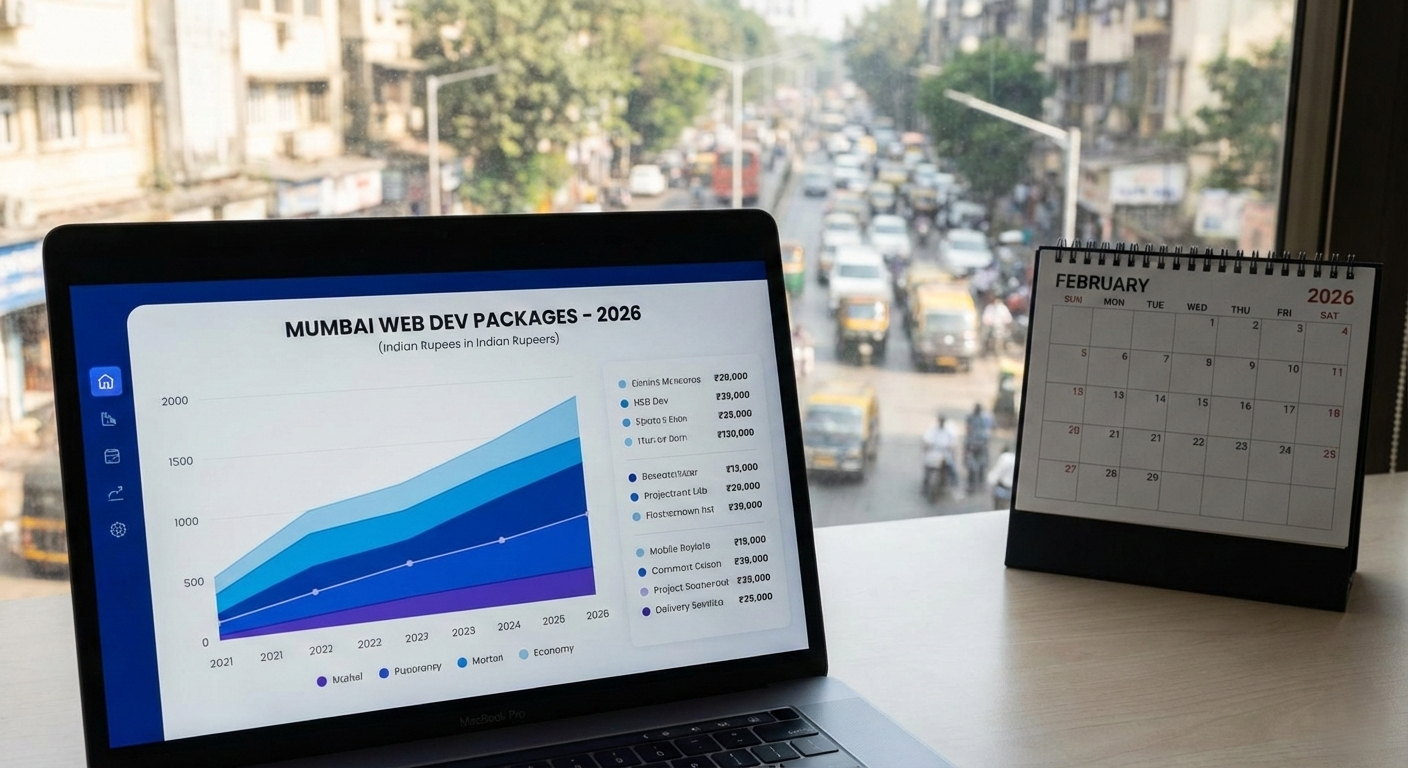
Introduction: Why Website Cost Feels Confusing in 2026
Ask five different agencies in Mumbai for a website quote in 2026 and you will usually get five completely different numbers. One proposal might say ₹20,000, another ₹80,000, and a “full-service” quote might cross ₹2,00,000 — all for what sounds like the same project.
The reality is that “website development cost in Mumbai” is not a single price point. It is the sum of design depth, technology choices, SEO, content, performance and the seniority of the team building it. If you do not see those components clearly, every quote feels random.
The common problem
You are asked for a budget before you understand what goes into a professional, conversion-focused website.
What this guide does
- • Puts realistic price ranges on common website types
- • Shows which decisions push your quote up or down
- • Explains the pricing models agencies use
Who it is for
Founders, marketing leaders and business owners who want to talk to agencies and freelancers with clarity, confidence and a realistic budget in mind.
By the end of this article you will know:
- Exact price bands for static, dynamic and e‑commerce websites in Mumbai in 2026
- The levers that meaningfully change your website cost (and which ones you can control)
- Which pricing model makes sense for your stage and risk appetite
- Practical ways to reduce cost without ending up with a low-quality, template-only build
Average Website Development Cost in Mumbai (2026)
Below is an approximate snapshot of website development cost ranges for Mumbai in 2026. These are realistic numbers we see in the market when working with professional freelancers and agencies focused on quality, not bare-minimum templates.
| Website Type | Complexity | Typical Cost Range (₹) | Ideal For | Timeline |
|---|---|---|---|---|
| Static 3–5 page website | Basic design, no CMS | ₹18,000 – ₹40,000 | Freelancers, consultants, very small businesses | 1–2 weeks |
| Dynamic business website (5–12 pages) | Custom design, basic CMS | ₹40,000 – ₹1,20,000 | SMBs, clinics, service businesses, agencies | 2–5 weeks |
| Professional brand website (strategy-led) | UX strategy, copy, animations | ₹80,000 – ₹2,00,000+ | Funded startups, B2B brands, multi-location businesses | 4–8 weeks |
| E‑commerce (up to 100 products) | Payments, inventory, shipping rules | ₹60,000 – ₹1,80,000 | D2C brands, boutiques, small retailers | 4–8 weeks |
| Advanced e‑commerce / custom web app | Custom flows, integrations, automation | ₹1,80,000 – ₹5,00,000+ | Marketplaces, multi-vendor, SaaS, larger brands | 8–16+ weeks |
These ranges assume you want a conversion-focused, mobile-first, SEO-ready website rather than a purely visual template. If you only need a basic presence, you can be at the lower end; if you want a strong brand and performance, budget towards the middle or upper end.
Key Factors That Affect Website Development Cost in Mumbai
Two businesses can both ask for a “simple website” and still end up at very different price points. Here are the main levers that move your quote up or down.
1. Number of pages & scope
More unique page layouts (home, about, services, blog, pricing, careers, landing pages) mean more design and implementation work. A focused 5-page website is very different from a 25-page corporate site with multiple layouts and content types.
2. Design depth & brand requirements
If you already have a strong brand system and just need it implemented, the cost is lower. If you need brand discovery, UX workshops, custom illustrations, animation concepts, and multiple rounds of exploration, budgets naturally increase.
3. Technology stack & content management
A static HTML/Tailwind site is fast and cost-effective for smaller projects. If you need a CMS (WordPress, headless CMS, custom admin panel) or integrations with CRMs, marketing tools, booking systems, or payment gateways, development and testing effort rises.
4. SEO, performance & analytics expectations
Some vendors only install a template and add your logo. Others, like Nexhivra, take time to:
- Plan information architecture and internal linking with SEO in mind
- Set up technical SEO (meta tags, structured data, sitemap, robots)
- Optimize for Core Web Vitals and Lighthouse scores
- Integrate analytics, conversion tracking, and basic funnels
These activities add hours — but they directly impact your ability to rank and convert.
5. Content, copywriting & photography
If you provide polished content, high-quality images, and clear messaging, the build is faster. When the team also needs to interview you, create messaging, write copy, and source images, the cost increases but so does the quality of the outcome.
6. Team structure (freelancer vs. agency)
A solo freelancer is usually more affordable but comes with bandwidth limits and higher dependency on one person. An agency has specialists (UX, UI, development, QA, SEO) and processes, which increases cost but reduces risk and speeds up delivery.
Cost by Website Type: Static, Dynamic & E‑commerce
1. Static brochure website
A static website is ideal when you need a professional online presence with a handful of pages and do not plan to update content frequently.
- Typical scope: Home, About, Services, Gallery/Work, Contact
- Tech: HTML, CSS (often Tailwind), light JavaScript
- Cost in Mumbai (2026): ₹18,000 – ₹40,000
- Best for: Freelancers, local professionals, micro-businesses
At Nexhivra, we still apply SEO basics (semantic HTML, meta tags, fast loading, mobile-first layout) even for simple static sites — so you get a professional foundation from day one.
2. Dynamic & business websites
Dynamic websites allow you to update content more easily and often include sections like blog, service pages, case studies, and landing pages for campaigns.
- Typical scope: 8–15 pages, blog, leads-focused landing page
- Tech: Modern frontend (React/Next.js) or CMS-backed WordPress/headless stack
- Cost in Mumbai (2026): ₹40,000 – ₹1,20,000+ depending on depth
- Best for: Growing SMBs, clinics, agencies, educational institutes
These builds usually include structured content, reusable components, and better integrations with tools like CRM, email marketing, or booking systems.
3. E‑commerce websites
E‑commerce projects add product management, inventory, payments, taxes, and fulfilment logic on top of a good storefront experience.
- Typical scope: Storefront, product listing, product detail pages, cart, checkout, order emails
- Tech: Shopify / WooCommerce / custom Next.js storefront + headless commerce
- Cost in Mumbai (2026):
- Smaller stores (up to 100 SKUs): ₹60,000 – ₹1,80,000
- Advanced stores or marketplaces: ₹1,80,000 – ₹5,00,000+
- Best for: D2C brands, retailers, lifestyle and fashion brands, B2B commerce
Because e‑commerce touches revenue directly, we recommend budgeting for conversion copy, CRO experiments, and ongoing improvements rather than just the initial build.
Common Website Pricing Models Used in Mumbai
When you speak to vendors, you will usually hear one of these three models. Understanding them helps you compare apples to apples.
1. Fixed-price projects
You agree on a detailed scope, deliverables, and timeline; the vendor quotes a single project fee.
- Pros: Clear budget, easier approvals, predictable cash flow.
- Cons: Less flexibility; any change after sign-off may require change requests.
- Best for: Projects with a well-defined scope and deadlines.
2. Hourly or day-rate billing
Designers and developers bill for time spent. This is common with freelancers and consulting teams.
- Pros: Flexible; ideal for iterative work and experiments.
- Cons: Harder to estimate total cost; requires trust and visibility.
- Typical rates (2026, Mumbai): ₹800 – ₹2,500 per hour depending on skill and niche.
3. Monthly retainers & ongoing partnerships
Instead of a one-time project, you treat your website as a living product and work with a team month-on-month.
- Pros: Continuous improvements, SEO work, experimentation and support.
- Cons: Recurring commitment; needs clear roadmap and metrics.
- Typical retainers: ₹25,000 – ₹1,00,000+ per month depending on scope.
At Nexhivra, we typically combine a fixed-fee project for the initial build with an optional lightweight retainer for improvements, SEO, and support once your new website is live.
Practical Tips to Reduce Website Development Cost (Without Cutting Quality)
You don’t have to choose between “cheap and bad” or “good but unaffordable”. With a bit of preparation, you can keep costs under control while still launching a professional website.
- Prioritise a lean first version (MVP website). List all pages you would like to have, then mark just the top 5–7 that move revenue or leads. Launch those first, and plan the rest over future phases.
- Prepare your content upfront. Even rough drafts of your services, FAQs, and team bios can save multiple rounds of back-and-forth. This reduces copywriting time and helps your designer focus on layout and clarity.
- Reuse proven layout patterns instead of reinventing everything. Good agencies know patterns that work for hero sections, pricing, and CTAs. Ask them to adapt winning structures to your brand instead of inventing completely new layouts.
- Be decisive about feedback and approvals. The more cycles a project goes through, the more time it consumes. Assign a single decision-maker, consolidate feedback, and keep communication tight.
- Choose the right technology for your stage. You might not need a fully custom web app on day one. A fast, static site or a light CMS can cover 80% of your needs today while still giving you room to upgrade later.
- Think total cost of ownership, not just build cost. A slightly higher upfront investment that includes SEO, performance, and clean code can save you from expensive rebuilds within 12–18 months.
FAQs on Website Development Cost in Mumbai (2026)
1. What is the minimum cost to build a website in Mumbai in 2026?
For a basic, but still professional, 3–5 page static website, realistic budgets start at around ₹18,000–₹25,000 with an experienced freelancer, and around ₹25,000–₹40,000 with a small agency. If you see quotes for ₹5,000–₹10,000, they often involve generic templates, no strategy, limited revisions, and minimal support.
2. How much does an e‑commerce website cost in Mumbai?
For a small store with up to 100 products, secure payments, and standard order flows, expect ₹60,000–₹1,20,000 depending on design depth and integrations. Larger catalogues, subscription models, or marketplaces can move the budget into the ₹1,50,000–₹4,00,000+ range, especially when you need advanced search, custom pricing logic, or integrations with ERP/CRM.
3. Why do different agencies quote different prices for the same website?
On paper the scope may look identical, but beneath the surface there are big differences in strategy, design quality, code quality, QA, SEO work, and post-launch support. Some teams simply configure a theme; others conduct discovery workshops, write conversion-focused copy, implement structured data, and rigorously test across devices. All of this shows up in pricing.
4. Can I start small and upgrade my website later?
Absolutely. In fact, this is often the smartest approach. At Nexhivra, we frequently recommend a phased rollout: launch a lean but strong first version, gather data on how visitors behave, and then invest in new pages or features that clearly move the needle.
When to Talk to Nexhivra About Your Website Budget
If you are a founder, marketing lead, or business owner in Mumbai, your website is often the first serious impression a prospect has of your brand. Treating it as a strategic asset — rather than a one-time expense — is what separates forgettable sites from those that consistently generate leads and revenue.
At Nexhivra, we build clean, modern, and high‑performance websites that balance aesthetics with performance, SEO, and maintainability. We are transparent about pricing, help you phase your roadmap, and suggest ways to reduce cost without compromising the experience.
If you would like a clear, line‑item estimate tailored to your use case in Mumbai:
- Share a short brief through our contact form
- Or explore our website development services first
We will respond within 24–48 hours with a recommended approach, budget ranges, and next steps — so you can make an informed decision, even if you don’t end up working with us.